
How much protein do you need each day? A practical guide to calculating your protein needs
- 4 minutes de lectura
- 17 Jun, 2026
Why is it so important to know how much protein we need?
Proteins are essential for building muscle, repairing tissues, keeping the immune system strong and sustaining vital processes such as the production of enzymes and hormones. However, one of the most common questions in nutrition is: how much protein do I need each day depending on my lifestyle and goals?
Working out your protein requirement is not as complicated as it seems, but it does mean taking into account your weight, your level of physical activity, your health goals and, of course, the quality of the foods you eat.
In this article you will learn how to calculate your protein needs step by step, and you will discover which are the most effective sources to meet them. We also answer the most searched questions on Google about this topic, such as “What happens if I consume too much protein?” or “Which foods have the most protein?”.
What are proteins and why are they so essential?
Proteins are made up of amino acids, some of which are essential (the body cannot produce them and we must obtain them through food). They are fundamental for:
The building and repair of muscle tissue.
The functioning of the immune system.
The production of enzymes and neurotransmitters.
Maintaining healthy skin, nails and hair.
How to calculate your daily protein needs (step by step)
Calculate your weight in kilograms
If you weigh yourself in pounds (lb), divide your weight by 2.20462 to get it in kilos.
Example: 154 lb / 2.20462 ≈ 70 kg.
Work out your activity level
Your activity level changes your needs. According to the guidance reviewed:
Sedentary (office work, little exercise): 0.8 g of protein per kg of body weight.
Moderately active (light exercise or work on your feet): 1.2 g/kg.
Active or sporty: 1.5 g/kg or more.
Example: If you weigh 70 kg and are moderately active:
70 x 1.2 = 84 grams of protein per day.
Spread your intake throughout the day
For better absorption, muscle repair and satiety, spread your protein across your meals. The guidance suggests:
If you eat 3 times a day → 20–30 g per meal.
If you have only 2 meals → 40–60 g per meal.
If you have 1 meal a day → more than 80 g in one go.
Which foods are rich in high-quality protein?
It is not only how much protein you eat that matters, but where it comes from. Foods with a high biological value have a complete amino acid profile, good digestibility and efficiency in protein synthesis.
According to the document “Top protein foods of the highest quality”, this is the ranking:
Foods with the highest-quality protein:
Category | Main examples |
Eggs | Whole, a complete and affordable source |
Shellfish | Mussels, clams, oysters |
Organ meats | Liver, kidneys (nutrient-dense) |
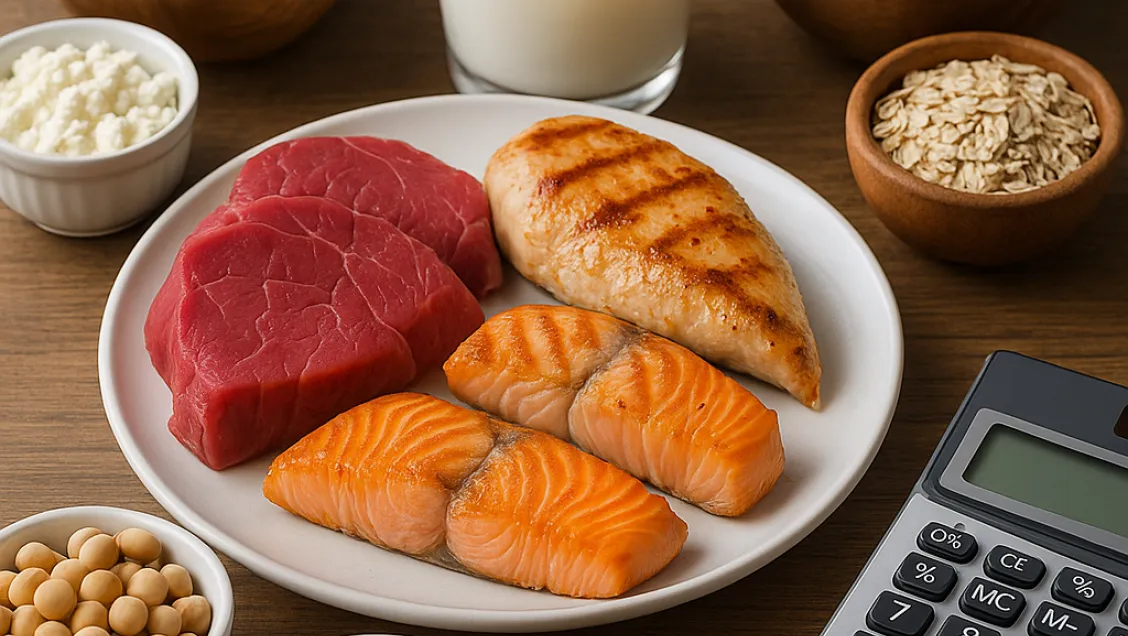
Meat and fish | Beef, lamb, chicken, salmon |
Full-fat dairy | Mature cheese, Greek yoghurt, kefir |
They include an optimal dose of leucine (a key amino acid for muscle) and a high density of nutrients such as vitamin B12, haem iron, zinc and essential fatty acids.
What happens if you do not eat enough protein?
A protein deficit can cause:
Loss of muscle mass, especially in older people.
A greater risk of infections.
Hair loss, brittle nails and dry skin.
Slow recovery from wounds or injuries.
A constant feeling of hunger.
And if I eat too much protein?
Excessive protein intake in healthy people is not usually harmful, although in the long term it may lead to:
Kidney strain (in cases of pre-existing kidney damage).
An increased risk of dehydration if it is not accompanied by enough water.
Nutritional imbalance if it displaces other essential nutrients such as fibre or healthy fats.
Is plant protein the same as animal protein?
Plant proteins (pulses, nuts, cereals) are valuable, but they usually have an incomplete amino acid profile. Combining them (e.g. rice + lentils) allows you to obtain a complete profile.
For vegans or vegetarians, it is key to diversify and reach higher amounts (1.4–1.8 g/kg depending on activity) to make up for their lower bioavailability.
Is it good to take protein supplements?
It depends. In most cases, a balanced diet can meet your requirements. However, they can be useful if:
You have little time to cook.
You have high requirements (athletes, older people).
You want to optimise post-training recovery.
The best options: whey protein, isolated plant protein (pea, rice, hemp) without added sugars.
Your protein requirement is more personalised than you think
There is no single amount for everyone. Calculating your protein needs means understanding your body, your routine and your goals.
It is also key to choose quality foods, prioritise complete protein and spread it correctly throughout the day.
In integrative nutrition, we do not just aim to meet quantities, but to optimise your cellular health, your metabolism and your vitality with nutrient-dense foods.
Frequently asked questions about daily protein
How much protein do I need if I exercise?
If you train 3–5 times a week, between 1.2 and 1.5 g/kg is recommended. If you do intense strength training or you are an athlete, you could need up to 2.0 g/kg.
How much protein should each meal have?
Ideally 20–30 g per meal spread across 3–4 meals a day, as studies on optimal protein synthesis and satiety show.
Do women need less protein than men?
Not necessarily. Needs are calculated per kilogram of body weight, not by sex. What varies is the weight and level of activity.
Is it bad to eat a lot of protein?
It is not harmful if you have good kidney function. However, going above 2.2 g/kg brings no extra benefits except in specific cases.
Is plant protein enough?
Yes, but it requires more planning to cover essential amino acids and may require larger amounts or combinations of foods.
Would you like a personalised plan for your case?
We analyse your body composition, habits and blood tests to design an individualised plan for you with integrative nutrition.
Get in touch with us with no obligation!
Book your assessment
Gratuita